Reflections vs Resolutions: An Invitation to Deeper Transformation in 2026

I have moved the blog to www.connectmentoringnetwork.org – but this is a personal one, thought I’d leave it here. Maybe you and I will visit from time to time at this site in 2026…. Let’s visit today, friend!

This year, what if we chose something deeper? Let’s take a look at reflections vs resolutions.

As we step into 2026, many of us feel the familiar pull of a new year—the clean slate, the fresh start, the pressure to decide who we will become in the next twelve months. I was ready to let go of 2025, and I’m excited for a new day in 2026 – check in here if you missed my last blog

If you are like me, “resolutions” seem to come to mind at the same time we think of a new year: goals to be thinner, stronger, more productive, more organized, more disciplined. While there is nothing inherently wrong with resolutions and goals that gear toward growth or intentionality, the danger is that our focus so easily drifts toward self-improvement while quietly neglecting soul formation.

reflections vs resolutions

Psalm 65:11 declares, “You crown the year with Your goodness, and Your paths drip with abundance.” This is not a picture of us striving to make the year good – it’s a picture of God Himself placing a crown of goodness upon it. The year ahead is not crowned by our resolve, our willpower, or our perfectly executed plans. It is crowned by the goodness of God. That truth invites us to begin the year not with pressure, but with trust. That truth may lead you to make reflections vs resolutions. 

Reflections vs Resolutions: 

Rather than asking, “What do I want to accomplish this year?” perhaps the better question for 2026 is, “Who am I becoming in Christ?”

Where have I been tempted to trust my own effort more than God’s goodness as I look ahead?

Scripture consistently calls us away from frantic striving and toward faithful abiding. In Isaiah 43:18–19, the Lord says,“Remember not the former things, nor consider the things of old. Behold, I am doing a new thing; now it springs forth, do you not perceive it?” God is not merely interested in helping us refine old patterns—He is inviting us into something new altogether. New depths of trust. New ways of walking with Him. New levels of surrender that cannot grow in soil cluttered by yesterday’s disappointments or successes.

However – perceiving the “new thing” God is doing requires space. Stillness. Souls that are not overcrowded by noise, hurry, and self-imposed expectations.

Reflections vs Resolutions: 

Rather than asking, “How can I improve on last year?” perhaps the better question for 2026 is, “Who am I becoming in Christ as He does something new in me?”

What former things might God be inviting me to release so I can perceive what He is doing now?

We live in a world that rewards hustle and measures worth by output. Even within Christian spaces, we can quietly absorb the belief that spiritual maturity is proven by how much we do for God. Yet Scripture reminds us that transformation flows from identity, not activity. “Therefore, if anyone is in Christ, he is a new creation. The old has passed away; behold, the new has come” (2 Corinthians 5:17).

This is not a future promise—it is a present reality. In Christ, we are already made new. Growth in the Christian life is not about earning a new identity, but learning to live from the one we have been given. When we forget this, our faith becomes performance-driven, and intimacy with God slowly gives way to pressure.

Reflections vs Resolutions: 

Rather than asking, “What spiritual habits should I add this year?” perhaps the better question for 2026 is, “Who am I becoming in Christ as I live from my new identity?”

Where might I be striving to prove my faith instead of resting in who I already am in Him?

Tending a soul is slow, intentional work. It looks like lingering in Scripture instead of rushing through a plan. It looks like prayer that is honest rather than polished. It looks like creating margin to listen, repent, trust, and return—again and again. Soul care is not flashy, but it is where intimacy with God is cultivated.

Jeremiah 29:11 reminds us, “For I know the plans I have for you, declares the Lord, plans for welfare and not for evil, to give you a future and a hope.” These words were spoken to people in exile—people living in the tension between promise and fulfillment. God’s good plans do not eliminate hardship, but they anchor us in hope and faithfulness while we wait.

Reflections vs Resolutions

Rather than asking, “How can I control what happens this year?” perhaps the better question for 2026 is, “Who am I becoming in Christ as I trust His plans?”

What would it look like to tend my soul instead of trying to manage every outcome?

As we enter 2026, many of us carry unseen burdens from the year behind us—losses, unanswered prayers, fatigue from doing all the “right things” without seeing fruit. Choosing intimacy with Christ does not ignore those realities, but it reframes them. Faithfulness is not measured by visible success, but by quiet obedience, daily surrender, and continued trust.

We can be confident of this: as we are faithful to God, He will surely be faithful to us. He always has been. He always will be.

Perhaps this year, we release the pressure to reinvent ourselves and instead choose abiding over striving. We choose depth over distraction. Faithfulness over frenzy. Formation over performance. Reflections vs resolutions.

May 2026 be a year crowned with His goodness. May your soul be tended with care. And may your greatest growth be found not in what you accomplish, but in who you are becoming in Christ. What a treasure that would be!

Let’s continue the conversation on the podcast! Join me on Thursday at 10:00 – subscribe here: https://www.youtube.com/@JenniferWSpivey

Want help achieving your resolutions in 2026? A new cohort is forming now at wwww.connectmentoringnetwork.org. All kinds of resources, all at your fingertips and all at your 
2025 Was That Year for Me

I have moved the blog to http://www.connectmentoringnetwork.org – but this is a personal one, thought I’d leave it here. Maybe you and I will visit from time to time at this site in 2026…. Let’s visit today, friend

I don’t think I realized how much 2025 took out of me until I finally paused long enough to look back. It was a year of so many changes—some expected, some sudden, some welcome, some unwelcome. A year where my mental, spiritual, and physical reserves were stretched in ways I never anticipated. In the same twelve months, grief can sit beside joy, loss can hold hands with gain, and exhaustion can coexist with wonder. That was the paradox, the tension, the beauty of this year.

Some years ask more of us than others. Some years feel like an uphill climb. Some years stretch us until we’re not sure how much more we can give. 2025 was that year for me.

Some years give more than we ever expected. Some years feel like a downhill run with the wind at your back. Some years fill you until you’re not sure your heart can hold any more gratitude. 2025 was that year for me.

All the changes—good ones, hard ones, and everything in between—pulled at my mental, spiritual, and physical energy. There were days I handled it with grace, and days I handled it with grit. 

And then there were days I handled it only because God held me together. (Can anyone else relate to “fake it ‘til you make it”? Those 29 years of “pastor’s wife frozen smile and I’m fine” came in handy on some days…. )

Some things this year turned out exactly as I had hoped or envisioned. Those were the moments that felt like fresh air—like God placing a gentle hand on my shoulder and whispering, “See? I’m working.”

Other things turned out so differently I had to fight to keep my footing. I had to remind myself to breathe, to pray, to steady my heart.

Some things came to such an abrupt halt that it made my head spin. Change that sudden can be jarring, even when we know God is sovereign.

And then—right alongside the hard—there were moments so full of joy I could hardly contain them. Laughter that surprised me. Blessings that overwhelmed me. Grace that arrived at the perfect moment. 

This year, seasons ended. New seasons began. Some doors closed quietly, others slammed shut. Some opened gently, and some burst open wide with opportunity.

Joy and grief sat in the same room.

Consolation and celebration shared the same table.

Loss and gain held hands.

I learned—again—that life rarely separates its emotions neatly.

2025 was that year for me.

Yet through every part of it, God was in it all: not just at the points of triumph, not only in the moments of clarity. He was present in the chaos, the confusion, the uncertainty, the exhaustion.

He was faithful when I felt strong.

He was faithful when I felt undone.

He celebrated when I celebrated.

Some days, He showed me the entire picture—how things fit together, where He was leading, how the pieces connected, how the dark was overcome by the light.

Other days, all I could see was the dark contrast. I couldn’t trace the outline. I couldn’t see the movement. I just had to trust that the dark would work with the light, that His hand was still shaping something good, that tomorrow would bring the illumination I lacked today.

2025 was that year for me.

I remembered an old song, and as the lyrics flooded back with all the memories that came along with it, I couldn’t stop the tears: 

Tears and fears and feeling proud to say, “I love you, ” right out loud

Dreams and schemes and circus crowds, I’ve looked at life that way

But now old friends, they’re acting strange; they shake their heads, tell me that I’ve changed

Well, something’s lost, but something’s gained in living every day

I’ve looked at life from both sides now, from win and lose and still somehow

It’s life’s illusions I recall, I really don’t know life at all

The gift is that I don’t have to know life at all – I have to know the One who holds all the days that string together to make a life.  I’m so grateful He holds this for me.

I think that’s one of the hidden gifts of a hard year, a blessed year, a growing year, a year that was all things at once: it teaches us to trust God not only when we understand Him, but also when we don’t. It teaches us that His goodness is not dependent on our clarity, and His faithfulness is not limited by our strength or our weakness.

Looking back, I can say this with certainty:

  • God did not waste a single moment of my 2025.
  • He used every joy, every shock, every ending, every beginning.
  • He held every tear and strengthened every step.
  • He stayed close when my world felt unsteady 
  • He celebrated with me when new life blossomed.

And as I step into a new year, I’m carrying these truths with me:

  • Even when something is lost, something is gained.
  • Even when the scene changes, God remains.
  • Even when I can’t see the full picture, His hands are already framing the next chapter.

And the next chapter is good – it will be good for you, too. As the psalmist said in 65:11, “You crown the year with Your goodness , And Your paths drip with abundance.” He did that in 2025 – 2025 was that year for me, His goodness, His abundance, exactly what I didn’t know to ask for. He’ll do it again in 2026, in 2027, in 2028, and so on until Jesus Christ returns. We are assured of that too, that  “He who has begun a good work in you will complete it until the day of Jesus Christ” (Phil. 1:6). 

I don’t know what the coming year will bring, but I do know this—I will walk into it with the same God who faithfully carried me through this one. His faithfulness and steadfast love is always the treasure ❤ 

Cheerleaders, Not Competitors

Competition has no place in the Kingdom of God. It’s not a principle of Heaven, and it’s certainly not the posture of a heart that understands who God is and what He’s building.

When I spent weeks blogging and podcasting about seasons of transition, I kept returning to this principle: whether you are the incoming leader or the outgoing leader, you are not the comparison—you are the cheerleader. However, this principle applies to every single person in the body of Christ. If you are serving Jesus, you are serving the Body – not creating competition within it.

Think about what comparison does. It isolates. It fuels insecurity. It says, “If you succeed, there’s less for me.” Let me remind you, friend: that is a lie straight from the enemy. God is not limited. Someone else’s blessing does not diminish your portion. If anything, it should remind you of the greatness of the Giver. There is no place for a scarcity mentality here.

When we forget this, we start comparing, striving, and even resenting what God is doing in someone else. There’s some red flags there, so hold up – Scripture reminds us over and over that we are one body. A hand should not work against another hand. An elbow should not oppose an eyeball. A shoulder should not trip up a toe. Each part matters. Each part plays a role. The body can only function properly when each part works together in unity.

Cheerleaders, on the other hand, celebrate progress and victory—whether or not they are the ones holding the trophy. They wave the banner of encouragement, not envy. They make noise for someone else’s moment, knowing that when one part of the body thrives, the entire body benefits.

Luke 5 paints this picture beautifully. When Jesus told Peter to put his nets back into the water after an exhausting, fishless night (is fishless a word? you get me!), the catch was so large that the nets began to break. What was Peter’s first reaction? Did he say, “I’ve got to keep this all to myself”? No. Scripture says he signaled for his partners in the other boat to come and help (Luke 5:6-7).

What God was doing for Peter was not just about Peter. It was about blessing others. It was about enlarging the circle of provision and letting the miracle overflow into other people’s boats.

That is how Kingdom success works. It’s never all about you. If God has given you a gift, a platform, or an opportunity, He’s given it not just to you—but through you—for the body of Christ. When someone else in ministry receives a breakthrough, launches a new program, publishes a book, grows their platform, or leads someone to Christ, it is not a threat to you. It is a reason to celebrate!

We live in a culture that often measures value by visibility and success by numbers. But Kingdom work isn’t measured that way. When one church thrives, the Kingdom advances. When another leader has a fruitful season, heaven rejoices. When heaven rejoices, that;’s our cue to rejoice as well!

Paul makes this clear in Romans 12:15: “Rejoice with those who rejoice; mourn with those who mourn.” This is not a suggestion—it is a command. A Christlike posture sees another’s success and says, “Thank You, Lord, for what You are doing in them—and through them—for all of us.”

Psalm 84 gives us another glimpse of God’s design for His people: “They go from strength to strength; till each appears before God in Zion” (v. 7). Notice the wording: they go—not he or she, but they. The psalmist is painting a picture of a people on pilgrimage together, drawing strength not just from God, but from one another, until every single one of them reaches the destination.

When I imagine standing before the Lord at the end of my race, I don’t want to come empty-handed or with a spirit of rivalry. I want to arrive arm in arm, hand in hand, raising up my brothers and sisters, celebrating what God has done in all of us. I want to know that I spent my life building others up—not tearing them down, not comparing, not competing—but cheering until the very end.

The beautiful truth about following Christ is that this is not a race where only one person wins. There are no podiums in heaven—only crowns laid at the feet of Jesus. We are all running toward the same finish line, all pursuing the same glory—His glory.

Friend, refuse to engage in competition within the body of Christ. Let’s cheer one another on with every ounce of faith and joy we have. When we finally stand before the Lord, my prayer is that we’ll be together—arm in arm, hand in hand—celebrating the goodness of God in all of us. Truth belongs to the Lord. Every gift, calling, or opportunity He places in our hands is not for our glory, but for the benefit of the body of Christ – and when we share joyfully, we share a treasure! ❤

Bearing One Another’s Burdens: a Two Way Street!

Galatians 6:2 says, “Bear one another’s burdens, and so fulfill the law of Christ.”

That little verse holds a very big idea. Paul is telling us that when we bear one another’s burdens—when we show love in tangible, practical ways—we are actually fulfilling the law of Christ. What law? The law that Jesus Himself gave us: to love one another, and to be known by that love.

It’s one thing to talk about love, but Paul takes it a step further. He reminds us to put feet on it. Love isn’t only a feeling; it’s an action. Bearing one another’s burdens means praying for each other, lifting each other up, helping each other, and taking action to care for one another in real and practical ways.

For me, this verse is both a comfort and a conviction.

This verse comforts me because it reminds me that I am not alone. If you’ve been with me for any length of time, you know how important relationships are to me. Of course, my relationship with Jesus comes first—but investing in spiritual friendships matters to me as well. This verse reassures me that community is part of God’s design. We weren’t made to walk through life alone.

This verse convicts me because it reminds me that bearing one another’s burdens goes both ways: it means that I share your burdens and also that you share mine.

The first part—helping others—that comes naturally to me. I’m honored to pray for someone, to encourage, to step in and help however I can. But the second part—the part where I’m the one who shares my burdens—doesn’t come as easily.

Can I be vulnerable with you? Somewhere along the way, I picked up a lie: “If I’m not perfect, you won’t love me.” Because of that lie, sharing my own burdens sometimes feels risky. What if I’m rejected? What if people see my weakness and step back instead of leaning in? Maybe you can relate?

The truth is, it’s hard to let others see the places where we’re weak – but if we keep everything inside, we’re missing the fullness of what God designed community to be. (I’m not suggesting that you tell everybody everything. That wouldn’t be wise. We need to use discernment and listen to the Holy Spirit about what to share and with whom. But keeping everything to ourselves isn’t wisdom either).

One of my favorite verses that reminds me of this truth is Psalm 103:14: “The Lord knows our frame; He remembers that we are dust.” God knows our weaknesses. He knows our limits. Still, in His kindness, He placed us in families, in communities, and in relationships with one another so that no one has to walk alone.

Sometimes we forget that perfection was never the expectation. Yes, some people may wrongly expect it, but God never does. He sees our weaknesses, and instead of rejecting us, He meets us with compassion. That’s the same heart we should have toward one another: grace, love, and a judgment-free space where burdens can be shared.

Isaiah 40:11 gives us a beautiful picture of how God deals with us: “He shall feed His flock like a shepherd; He shall gather the lambs with His arm, carry them in His bosom, and gently lead those who are with young.”

What a picture of gentleness. Our Shepherd doesn’t deal harshly with us. He carries us close to His heart. He leads us with tenderness. He loves us when we’re strong and when we’re weak, when we get it right and when we get it wrong. Friend, He delights in you. On your best days and on your worst days, you are a delight to the Lord.

When we live in that freedom—resting in His love—we can extend the same freedom to others. We can walk in grace toward one another, allowing our community to be a safe place where burdens can be shared.

John 3:16 is a verse many of us learned as children: “For God so loved the world that He gave His only Son, that whoever believes in Him should not perish but have eternal life.”

But we often forget to read the very next verse: “For God did not send His Son into the world to condemn the world, but that the world might be saved through Him” (John 3:17).

Our salvation is a free gift. It’s not something we can earn, and it’s not something we can lose by not being “perfect enough.” There is no condemnation in Christ.

If that’s true, then our communities should reflect the same freedom. Bearing one another’s burdens should never come with fear or judgment. You should be able to come to me without fear, and I should be able to come to you without fear—because we’re not trying to meet an impossible standard. We’re simply living as beloved children of God.

If you serve in ministry—a pastor’s wife, pastor, small group leader, Bible study teacher—this can feel even harder. There’s a real (or sometimes imagined) pressure to appear perfect in front of those you serve. I’ve felt that too.

Let me encourage you: don’t be afraid to be vulnerable. Don’t carry the weight of perfection on your shoulders. As you bear the burdens of others, also allow others to bear yours. That’s not weakness—it’s obedience.

When we do this, letting this burden sharing happen on both sides, we’re not just helping each other. We’re fulfilling the law of Christ. Let’s be the kind of people who carry each other’s burdens. Let’s create spaces where it’s safe to be honest, where grace and love flow freely, and where no one has to fear rejection.

We don’t have to be perfect to be loved—by God or by each other. And when we live that way, we fulfill the very law of Christ: to love one another as He has loved us. What a treasure that is! ❤

The Scared Steps that Build Our Faith

There’s a saying floating around in the self-help world: “Do it scared.”

It’s catchy. It’s inspiring. And it’s a whole lot easier said than done.

When fear shows up, our first instinct is often to stop, freeze, or retreat. We imagine that in order to move forward, we have to first get rid of the fear. Know this: fear isn’t always a stop sign. Fear can be an indicator that we’re stepping into something bigger than ourselves.

Almost every time God says “do not fear” in Scripture, He couples it with a promise of His presence:

  • “Do not fear, for I am with you; do not be dismayed, for I am your God.” (Isaiah 41:10)
  • “For I, the Lord your God, hold your right hand; it is I who say to you, ‘Fear not, I am the one who helps you.’” (Isaiah 41:13)
  • “Even though I walk through the valley of the shadow of death, I will fear no evil, for you are with me.” (Psalm 23:4)
  • “God is our refuge and strength, an ever-present help in trouble. Therefore we will not fear…” (Psalm 46:1–3)
  • “Do not be afraid of them; the Lord your God himself will fight for you.” (Deuteronomy 3:22)
  • “Be strong and courageous. Do not be afraid or terrified… for the Lord your God goes with you; He will never leave you nor forsake you.” (Deuteronomy 31:6)
  • “The Lord is my helper; I will not fear; what can man do to me?” (Hebrews 13:6)

We sometimes imagine fear as a weakness or a flaw, but Jesus understands fear intimately. Hebrews 4:15 reminds us that He experienced every emotion we do—without sin. He knows what it feels like to be pressed by uncertainty, threatened by danger, and pulled into the tension of “this is hard, but I must obey.” Fear is human.

Remember the Garden of Gethsemane? Jesus prayed in deep distress, fully aware of the suffering to come, and still He walked forward in obedience. That’s not the absence of fear—that’s courage grounded in the Father’s will.

Maybe “do it scared” isn’t about pushing through in our own strength while fear gnaws at the edges of our courage. Maybe it’s about doing it with fear… Not fear/scared but fear/confidence in the Lord. The kind of confidence that says, “Yes, my heart is racing, but my God is here. My knees might be shaking, but my Savior’s hand is holding mine. I may tremble, but His promises will not.”

Vulnerable moment: I get scared sometimes. I can be full of faith and still feel the thump of anxiety in my chest. (Okay, to be really honest – I feel it in my stomach – that kind of dropping, didn’t finish my homework, might throw up kind of feeling). I’ve learned that I can hold fear and faith together, the way I’ve held joy and grief at the same time. Sometimes I can switch from fear scared to fear confident in the Lord as quickly as flipping off a light. Fortunately, when the light in my soul flickers off, the Holy Spirit is there to switch it back on. Every time.

The Holy Spirit doesn’t shame us for feeling fear. He simply displays the truth again and again—reminding us of God’s promises, steadying our breath, whispering the courage of Scripture into our hearts. In that light that He switched back on for me, I can do anything He’s called me to do. Not because fear is gone, but because His presence is greater.

And you can, too.

When David wrote Psalm 23:4—“Even though I walk through the valley of the shadow of death, I will fear no evil”—he didn’t deny that the valley existed. He didn’t minimize the shadows. He simply placed the reality of God’s presence above the reality of danger.

That’s what “do it scared” looks like for a believer: not blind bravado, not pretending fear doesn’t exist, but taking the next step because the Lord is with us.

Every time we take that step, something happens: fear loses just a little more of its grip. Faith grows a little stronger. We start to see God’s fingerprints not just on the moments when we felt brave, but on the trembling moments when we leaned on Him most.

If you’re standing at the edge of something right now—something that feels risky, uncomfortable, or overwhelming—here’s a prayer for you:

Lord, You know my fears. You know how my heart races when I think about what lies ahead. Thank You for the reminder that You never leave my side. Give me courage to take the next step, not because I feel strong, but because You are my strength. Let Your presence be more real to me than my fear. In Jesus’ name, amen.

You don’t have to wait until you “feel” ready. You don’t have to wait for the fear to disappear. If God has called you, He’s already promised to go with you. Take the step. Make the call. Start the project. Have the conversation. You aren’t alone, and moving forward in the knowledge that God has you on every side is a treasure ❤

More Sure than Sunrise

This morning, as I went through my usual routine, I noticed something written on the bottle of my face wash: “targets 100% of daily pollution.” It caught my eye, but not for the reason the marketing team probably intended. I paused and thought, “That phrase actually means nothing.”

Sure, it targets 100%—but does it actually hit 100%? “Targeting” doesn’t guarantee success. It doesn’t even necessarily imply effort. I can target anything all day long and never come close to actually hitting it. I’m sure when I bought that face wash, I read the label and thought, “Oh okay, 100%,” trusted it blindly and moved on without a second thought. We’ve gotten so used to empty phrases that we barely notice them anymore.

I thought about that phrase through the morning. Later, as I tossed a load of laundry into the washer, I realized that I don’t even question whether the clothes will come out clean. I trust that the detergent will do its job. I don’t second-guess the rinse cycle. I just press “start” and walk away in full confidence that it’s going to work. Again, I wondered: what else do I trust in blindly?

It’s a silly question at first glance, but really… do I have more immediate confidence in man-made systems and mass-produced products than I do in the very words of God?

In our world, we’re constantly bombarded by words that sound important but lack substance. Commercials, slogans, political speeches, even everyday conversations—so much of what we hear is padded with fluff and exaggeration. Our culture has become comfortable with over-promising and under-delivering. Without realizing it, we start to read everything with a filter of skepticism.

But this can never be applied to God’s words. Our casually adopted skepticism or blind trust don’t belong here when we open our Bibles.

To be honest, Jesus said some things that are so big and bold that they could be hard to believe at times, but every word is true!

  • He IS our Healer. (Isaiah 53:5)
  • He IS our Intercessor. (Romans 8:34)
  • He IS our Best Friend. (John 15:15)
  • He IS our Savior. (Luke 2:11)
  • He IS our High Priest who understands both our deepest pain and our greatest joy. (Hebrews 4:15)

Beyond being true, He invites us to question, understand, and know. We don’t have to look at the label and say “oh, He’ll heal” as if it is a casual phrase with no meaning. These aren’t just poetic phrases or theological vocabulary. These are realities. They’re promises backed by the character of a God who cannot lie (Titus 1:2). Jesus doesn’t just target our needs—He fulfills them. He doesn’t aim vaguely in our direction—He comes close and delivers every single time. Sure, you can trust Him blindly, that’s no problem. Unlike the person who wrote “targets 100% of daily pollution” and hopes you buy it without question (like I did!), God asks us to test Him, taste and see that He is good. What a comfort it is to have the promise, understand the promise, be able to stand in it and understand it as you see His word come alive and come to pass in your own life.

Here are a couple of favorites, invitations from the Lord to not only trust Him but also understand Him:

“Oh, taste and see that the Lord is good;
Blessed is the man who trusts in Him!” Psalm 34:8

“….Test me in this,” says the Lord Almighty, “and see if I will not throw open the floodgates of heaven and pour out so much blessing….” Malachi 3:10

One more today: Psalm 130:6 says, “My soul waits for the Lord more than those who watch for the morning—yes, more than those who watch for the morning.”

Those who “watch for the morning” are the night guards, the sentries on duty before dawn. They’ve spent hours in the dark, and they know the morning is coming. They don’t wonder if the sun will rise—they know it will. Their waiting is filled with anticipation, not doubt. The psalmist says his soul waits for the Lord even more than that. The psalmist is more convinced that God will show up in his life than he is that the sun will rise in the morning.

Are we that convinced? We can be. Because unlike the world’s empty words and broken promises, the words of God are always reliable, always true. Numbers 23:19 reminds us:

“God is not a man, that He should lie, nor a son of man, that He should change His mind. Does He speak and then not act? Does He promise and not fulfill?”

Everything God has said, He will do. Every word He’s spoken, He will keep. His truth is more constant than the sunrise and more dependable than any product or process you’ve ever trusted.

So what do we do with this?

First, we learn to take God at His Word. We read Scripture and believe it. Not as poetry or philosophy, but as living truth. If He says He is near to the brokenhearted, He is. If He says He’ll never leave us, He won’t. If He says His grace is sufficient, it is.

Second, we let His faithfulness shape the way we speak. Jesus said in Matthew 5:37, “Let your ‘yes’ be ‘yes,’ and your ‘no,’ ‘no.’ Anything more than this comes from the evil one.”

If we are children of God, then our words should carry weight, too. No fluff, no exaggeration, no glossing over promises we don’t intend to keep. We reflect the heart of God when our words are trustworthy—when what we say actually means something.

I encourage you to look at the words of the Lord not like you look at a marketing label, but like you look at the sunrise: unchanging, trustworthy, certain. More certain than the day itself.

Jesus can be trusted. More powerful than any product. More dependable than the sun. Let His truth bring you confidence and peace. No matter where you are in the waiting – whether it is for the sun to rise or the season to change, confidence in the Lord is a treasure ❤

Don’t Wait: Make the First Move!

Spiritual friendship is not just “nice to have” in the Christian life—it’s essential.

“Two are better than one… If either of them falls down, one can help the other up.” Ecclesiastes 4:9, 10

Have you ever hesitated to reach out to someone, afraid of being rejected or misunderstood? Maybe you saw someone at church who looked a little lonely, or a mom at the park who seemed like she might want a chat. You thought, “I should go say something”, but then quickly talked yourself out of it…. Let’s be honest—friendship on its own can feel risky, but being the one to make the effort ups the risk for sure. 

Let’s start with the obvious: initiating friendship feels vulnerable. You don’t know how you’ll be received. You risk feeling awkward, ignored, or even rejected. In our social-media-saturated world, it’s easy to stay in our own bubble, where we scroll, like, and comment without ever truly engaging.

From the beginning, God said, “It is not good for man to be alone” (Genesis 2:18). While that verse speaks to marriage, the principle really is broader. We are created for connection. Scripture is full of examples of deep, godly friendships: David and Jonathan, Ruth and Naomi, Paul and Timothy, Jesus and His disciples.

Still, we hesitate.

We tell ourselves lies like:

  • She probably has enough friends already.
  • What if she thinks I’m too much?
  • I don’t want to come across as needy.
  • I’ve been burned before—I’m not doing that again.

All of those fears are valid—but fear doesn’t get to have the final say. When it comes to godly friendship, the return on investment is greater than we can imagine. God’s best for you happens in community; it’s the enemy of your soul who wants you in isolation.

Jesus Himself modeled what it means to initiate relationship – we talked about this on the blog a few weeks ago.  Check it out here if you missed it!

Jesus invited Himself over. Jesus made the first move. If the Son of God was willing to reach across social barriers, awkward situations, and the opinions of others to extend friendship, shouldn’t we be willing to do the same? The truth is, anything worthwhile involves some level of risk, and that includes friendship.

Friendship doesn’t happen by accident. It’s not something we stumble into—it’s something we choose to build. Like any investment, it requires intentionality, time, and sacrifice.

I loved morning car rides with my children on the way to school when they were small many years ago. There were a couple of verses that were on the usual rotation, and one that was repeated often was Proverbs 18:24. “A man who has friends must himself be friendly.” That’s not just a cute quote—it’s a reminder that friendships grow when we’re willing to plant seeds.  

Sometimes those seeds look like:

  • Sending the first text.
  • Asking someone to grab coffee.
  • Sitting next to someone new at church.
  • Starting a conversation, even when you feel awkward.

Prepare yourself: not every seed grows into a deep friendship. Some fade. Some were only meant for a season. However, some grow roots so deep that they strengthen your faith, bring you joy, and sharpen you into the person God is calling you to be. Those kinds of roots bring forth good fruit, friends who will:

  • Speak truth when we’re tempted to believe lies
  • Pray for us when we don’t have the words
  • Celebrate our victories and mourn our losses
  • Keep us accountable and point us back to Christ
  • Lift us up when we feel down

That kind of friendship doesn’t just happen. It starts with someone being brave enough to go first.

Here’s the thing: you’re not the only one longing for connection. That woman you keep thinking about inviting to coffee? She might be praying for someone like you. The young mom sitting by herself at small group? She may be hoping someone notices her.

Someone is waiting for you to be bold. Not perfect. Just willing.

This week, take a step toward friendship. Plant the seeds. Show yourself friendly.

  • Send the text. 
  • Invite the person. 
  • Sit next to someone new. 
  • Smile first. 
  • Speak up. 
  • Be the one who reaches out.

Are you nervous or unsure? That’s okay, don’t let those feelings stop you. Friendship built on faith, truth, and love is worth every bit of risk and effort. Remember that Jesus made the first move toward us. He came close. He extended His hand. Let’s follow His lead.

Godly friendship is a treasure – but many times you have to make an effort to enjoy it’s benefits!

p.s. I’m continuing this discussion on the podcast this week! New episode will drop on Thursday. Subscribe on Youtube, Spotify or Apple Podcasts this week so we can connect again! Here’s the link tree so we can connect!

Watch Out for the Baobabs!

Paul encourages Titus (and by extension, us) in Titus 1:15: “To the pure all things are pure, but to those who are defiled and unbelieving nothing is pure; but even their mind and conscience are defiled”. 

“To the pure all things are pure”, I love that.  I think it means that I can find Jesus and joy in everything,  Purity in heart could be the lens through which we view everything. Using that perspective, I’ll share a little something: 

Antoine De Saint Expury wrote a book in 1943 entitled “The Little Prince”. It’s one of my favorites (and no, its not a “Christian” title – this is a to-the-pure-all-things-are-pure-situation, remember?).  Every great once in a while, I’ll take it out and read it all in one sitting, all by myself, preferably on the favorite spot on my back porch, lake view and solitude. I love the language, I love the story, I love the illustrations. I don’t highlight it and underline, but maybe I should – I love the little life lessons! Here’s one that stands out today:

“It’s a question of discipline,” the little prince told me later on. “When you’ve finished your own washing and dressing in the morning, then it is time to attend to the washing and dressing of your planet, just so, with the greatest care.  You must see to it that you pull up regularly all the baobabs, at the very first moment when they can be distinguished from the rose-bushes which they resemble so closely in their earliest youth.  It is very tedious work,” the little prince added, “but very important….. Sometimes, there is no harm in putting off a piece of work until another day. But when it is a matter of baobabs, that always means a catastrophe.”

Let that sink in for a minute: “It is very tedious work, but very important.

Solomon 2:15 communicates something similar in a different way: “Catch us the foxes, the little foxes that spoil the vines, For our vines have tender grapes.”

This isn’t a “one and done” situation. Solomon’s little foxes, like the little prince’s baobabs, had to be tended to daily. The “little foxes” were things that seemed small, until they were allowed to get out of control. The “little foxes” are things in our own lives that we might ignore or gloss over or get to another day until we don’t get to them at all.

Sometimes, there is no harm in putting off a piece of work until another day. But when it is a matter of baobabs, that always means a catastrophe.”

Sometimes a delay isn’t harmful. Y’all know I practice Sabbath (you should too! I wrote about it here), I practice a “rule of life” (hey, let’s talk about that one soon!), and there are times in life when we need a rest. Life happens sometimes, things get delayed sometimes, but these interruptions or surprises should be the exception, not the norm.

What are “little foxes” for you? What are things in your life that you should tend to daily? My suggestion is that you include spiritual foundational disciplines: Prayer, Giving and Service, Bible Study, Church Attendance, Worship, Sabbath, Spiritual Friendships, Love, Operating in the Fruit of the Spirit, Fasting…. Your vines have “tender grapes”, the little prince’s planet was small, ignoring the foxes and the baobabs always means a catastrophe. Maybe not at first – it might take you a little time to realize that you have lost your “first love”, but that’s how the enemy of your soul operates. Slowly, subtly, a drift so gradual that you fail to notice that you are slipping away.

It’s a question of discipline, tending to these daily practices. The beautiful thing is: when you cultivate these habits, your love for the Lord will grow. You will be drawn closer to His heart. These daily disciplines will anchor your love for God, and guess what? The “little foxes” and the “baobabs” won’t stand a chance!

Even if it seems tedious at times, that’s a treasure!

“Where Are You?” (Part 2): The Blessing Is in the Place of Obedience

Last week, I asked a question: “Where are you?” (Genesis 3:9). It wasn’t a question of physical location, but of spiritual alignment. Are you where God has called you to be—not just geographically, but emotionally, spiritually, mentally?

This week, let’s go one step deeper. Let’s not just ask, “Where are you?”—let’s reflect on why it matters. Here’s the truth:

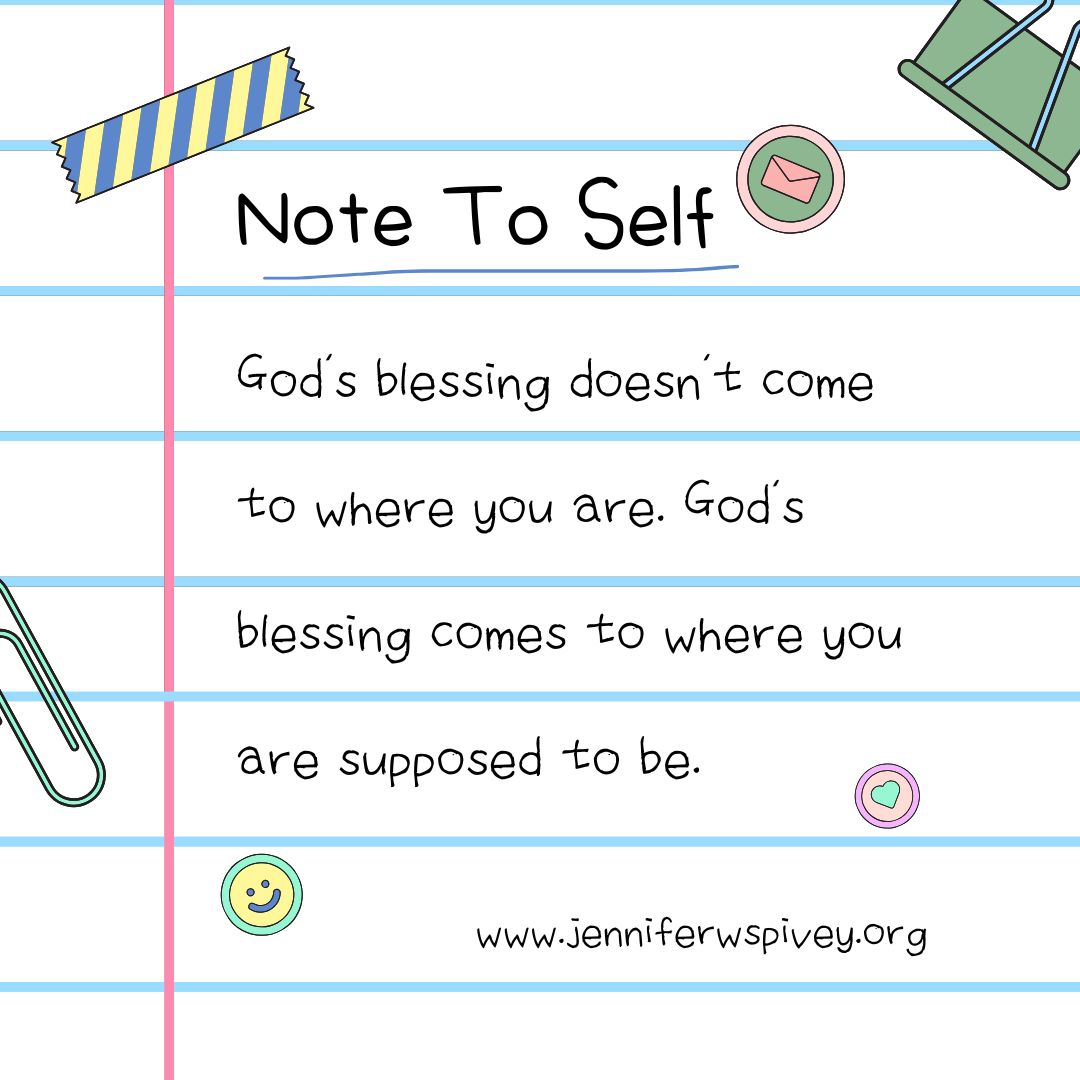
God’s blessing doesn’t come to where you are. God’s blessing comes to where you are supposed to be.

That might sound a little unsettling at first. After all, wouldn’t a loving God meet us right where we are?

The answer is a resounding YES! He absolutely does meet us with mercy, grace, and compassion right where we are. However, when it comes to purpose, provision, and blessing, the Word of God shows us a consistent pattern: His best is released in the place of obedience.

Psalm 37:23 tells us, “The steps of a good man are ordered by the Lord: and he delighteth in his way.” (Sorry, I reverted to the KJV for a sec there, it’s a familiarity thing for me!)  Here’s the NLT: The LORD directs the steps of the godly. He delights in every detail of their lives.”

Let that sink in: your steps are ordered. That means every twist, every turn, every detour that didn’t make sense—God has a plan for it. But there’s a catch. If steps are ordered, then there’s a direction we’re expected to walk in. And if we veer off that path—due to fear, disobedience, or comfort—we may find ourselves out of sync with the very blessings we’ve been praying for.

How about Jonah? God gave him clear instructions: Go to Nineveh. Instead, Jonah ran the other way, boarding a ship to Tarshish. Jonah didn’t lose his calling—he lost his footing. With his disobedience came consequences: a violent storm, a frightened crew, and a three-day stay in the belly of a great fish.

Why? Because God’s provision was never in Tarshish. The miracle Jonah was called to be part of was waiting in Nineveh.

Too often, we make decisions based on what feels good or what looks safe. But comfort is not confirmation. Just because it’s easy doesn’t mean it’s God. Just because it’s hard doesn’t mean it’s not God.

Being in the right place doesn’t always feel pleasant—but it’s always worth it. The question is: Are you where God told you to go, or are you where it’s comfortable? God’s purpose isn’t passive. It’s positioned. It calls us to move, to shift, to step out—even when it’s scary or inconvenient. Sometimes, the place we want to be is not the place we’re supposed to be. Do not make the mistake of allowing your comfort to compete with your calling.

In 1 Kings 17, we meet the prophet Elijah in a time of severe drought. God speaks to him and says:

“Leave here, turn eastward and hide in the Kerith Ravine, east of the Jordan. You will drink from the brook, and I have directed the ravens to supply you with food there.” (1 Kings 17:3–4, NIV)

God doesn’t just say, “I’ll take care of you.” He gives Elijah a very specific instruction—go there. Why? Because that’s where the blessing is. That’s where the provision has been appointed. If Elijah had stayed put or gone his own way, he would have missed the miracle. The provision was real. The blessing was ready. But it was tied to the location that Elijah would arrive at through obedience.

Sometimes, we wait for God to bless us in the wrong place. We want breakthrough without obedience. We want favor without surrender. God’s blessing isn’t random—it’s relational. It’s unlocked when we walk with Him in trust and obedience.

Hebrews 11 is full of people who were blessed because they moved:

  • Abraham left everything familiar to go to a land God would show him—and became the father of many nations.
  • Moses walked away from Pharaoh’s palace and into a wilderness of uncertainty—only to become the leader of a great exodus.
  • Ruth left Moab and followed Naomi into Bethlehem—where she stepped into divine legacy and became part of the lineage of Jesus.

They all had one thing in common: they didn’t stay where it was easy. They followed God into the unknown. And because of that, they stepped into destiny.

Let’s circle back to the original question: where are you?

Not just in the physical sense—but in your obedience, in your faith, in your surrender. Are you waiting for God to bless a place He never sent you? Are you asking Him to show up in a situation you weren’t called to?

If so, maybe it’s time to shift. Not out of shame or guilt—but out of love and invitation. God’s not trying to punish you, He’s trying to position you.

The goal is not to be just anywhere. The goal is to be in the center of His will. Perfectly positioned, surrendered, expectant. God is faithful to provide for His purpose. His purpose is always found in the place He calls you to be.

Here are a few reflection questions to take to prayer:

  1. Am I currently in a place of obedience, or just a place of comfort?
  2. What instructions has God given me that I’ve delayed or ignored?
  3. Where have I been asking God to bless my plan instead of following His?
  4. What step do I need to take today to move toward obedience?

You don’t have to have all the answers. Let’s just purpose to take the next right step.

Remember: the blessing of the Lord is not where you are, it’s where you’re supposed to be – and finding yourself in that sweet spot, ready to receive it? That’s a treasure!